
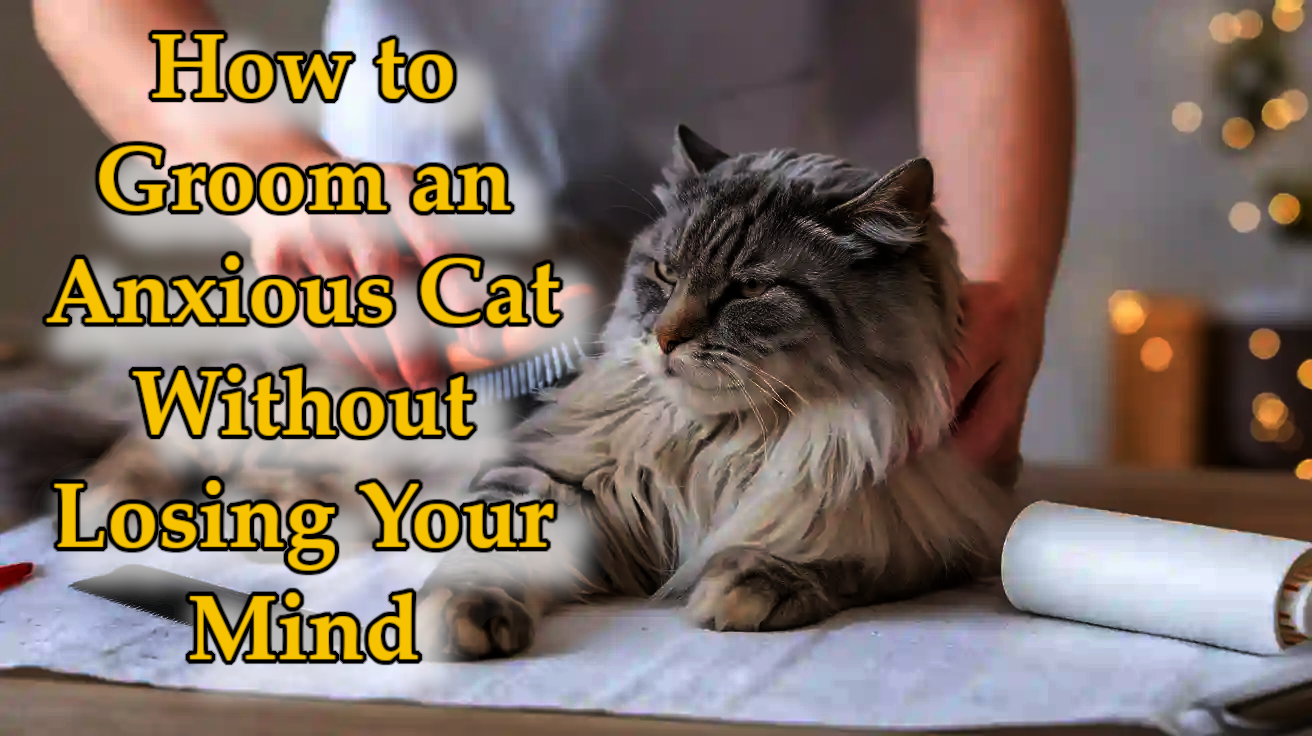
How to Groom an Anxious Cat Without Losing Your Mind (Or Getting Scratched)
By Sarah Johnson | CatParentsGuide
By the CatParentsGuide editorial team · Based on veterinary sources
This article is informational only and does not replace veterinary advice. If your cat seems unwell, contact your veterinarian.
You have a cat who hides under the bed the moment you pick up a brush. You have tried everything. You have been gentle. You have used treats. Nothing works. Learning how to groom an anxious cat is not about finding the perfect brush or the right shampoo. It is about understanding why your cat panics and working with that fear, not against it.
Your cat is not being difficult. Your cat is terrified. And once you accept that, you can start fixing the problem. This guide walks through why cats panic during grooming, how to desensitize them step by step, and when to bring in a professional.
The short answer: to groom an anxious cat, start by desensitizing her to grooming tools through positive association (treats near the brush for several days), use a grooming glove instead of a brush, keep sessions very short, and always stop at the first sign of stress. Never push through fear signals.
- An anxious cat panics for identifiable reasons: past pain, sensory overload, physical discomfort, or loss of control.
- Desensitization and counter-conditioning mean pairing the tool with something positive, slowly.
- Start with a grooming glove or soft rubber brush before trying a slicker brush.
- Stop at the first stress signal. Every time you stop, you build trust.
- If home grooming causes severe fear, a professional groomer or vet is the kinder choice.
What’s in this guide
- Why your cat panics during grooming
- The most important step before you pick up any tool
- How to actually brush an anxious cat
- What to do when your cat shows stress signals
- The best tools for anxious cats
- Nail trims when your cat hates paw handling
- What about bathing?
- Calming aids that actually work
- When to get professional help
- A realistic timeline
- Frequently asked questions
- The bottom line
Why your cat panics during grooming
Most cat owners assume their cat hates them or is being stubborn. That is not what is happening. Your cat panics for one or more of these reasons.
1. Past pain
Maybe someone once pulled a mat too hard. Maybe a nail was cut too short. Maybe water was too hot or too cold. Cats remember pain for years. Your cat is not holding a grudge. Your cat is terrified of feeling that pain again. This is clinically referred to as a negative associative memory, and one bad experience can create a lifelong fear response.
2. Sensory overload
Cats have much more sensitive hearing than we do. The snip of clippers sounds like a gunshot to them. The spray of water sounds like danger. What feels like a normal grooming session to you feels like being trapped in a noisy, chaotic room to your cat.
3. Physical discomfort
This one gets overlooked constantly. Older cats often have arthritis. Brushing their back hurts. Lifting their paw hurts. They cannot tell you their joints ache. They can only hiss or run away. If your senior cat suddenly stops tolerating brushing, a vet exam should be the first step.
4. Loss of control
Cats are not dogs. They do not naturally accept being held in place. When you restrain your cat for grooming, her brain screams “predator.” She is not being dramatic. She is following an instinct that kept her ancestors alive.
Understanding these reasons is the first step. The solutions come from working with these fears, not fighting them.
The most important step before you pick up any tool
Do not touch your cat with a brush for at least one week. The biggest mistake people make is trying to groom an anxious cat without doing the groundwork first. You need to rebuild trust before you can groom.
This process is called desensitization and counter-conditioning. It sounds fancy, but it just means slowly getting your cat used to the tool while pairing it with something positive.
The 7-day desensitization protocol
Days 1 to 7: place the brush near your cat’s food bowl. Let her eat next to it. Do not pick it up. Do not move it toward her. Just let it exist in her safe space.
Every time your cat looks at the brush or sniffs it, give her a treat. Not a regular treat. Something special. Freeze-dried chicken. A bit of tuna. Something she only gets during this training.
By day three or four, most cats start to ignore the brush. By day seven, some will even rub against it. That is when you know you are ready for the next step.
How to actually brush an anxious cat
Once your cat is comfortable with the brush being nearby, you can start the actual grooming. But not the way you think.
Step 1: brush without brushing. Take the brush and simply rest it on your cat’s back for one second. Then remove it. Give a treat. That is the whole session. Do this once a day for several days.
Step 2: one stroke. After your cat accepts the brush resting on her, do one gentle stroke from shoulder to mid-back. Stop. Give a treat. Do not do a second stroke. End the session. Repeat this for several days.
Step 3: two strokes. Gradually increase to two strokes. Then three. Then four. But never go beyond what your cat comfortably accepts.
Step 4: move to new areas. Once your cat treats brushing on her back as normal, try the sides. Then the chest if your cat allows it. Save the belly, tail, and paws for last. Some cats never accept brushing on their belly. That is fine. Do not force it.
The entire process from step one to step four might take a month. That is normal. You are not failing. You are building trust.
What to do when your cat shows stress signals
You need to learn your cat’s specific stress signals. Every cat is different. Some flatten their ears. Some twitch their tail. Some lick their lips repeatedly before hissing.
Common stress signals to watch for:
- Tail twitching or thumping
- Skin rippling along the back
- Ears turning sideways or flattening
- Dilated pupils even in bright light
- Trying to move away from you
- Low growling or hissing
The moment you see any of these, stop. Not “finish this section.” Stop immediately. Put the brush down. Offer a treat if your cat will take it. Let her leave.
If you push through these signals, you are teaching your cat that grooming is something to fear. Each time you stop when she asks you to stop, you teach her that you listen. That builds trust. For a deeper look at what stress looks like during grooming, see our guide to 7 signs your cat is stressed during grooming and when to stop.
The best tools for anxious cats
Not all grooming tools are created equal for anxious cats.
| Tool type | Best for anxious cats? | Why it works or why to avoid |
|---|---|---|
| Grooming glove | Excellent starter tool | Mimics natural petting. No scary handles or metal pins. Most anxious cats do not even realize they are being groomed. |
| Rubber brush | Good for massage and loose hair | Soft rubber nubs massage rather than scrape. Completely silent. |
| Slicker brush | Avoid initially | Can feel sharp and prickly on sensitive skin. The metal pins look threatening to cats. Only introduce after your cat accepts gentler tools. |
| Electric clippers | Avoid entirely for home use | The buzzing sound triggers panic in most cats. Leave shaving to professional groomers or vets. |
Start with a grooming glove. These silicone gloves let you pet your cat while removing loose fur. Most anxious cats do not even realize they are being groomed. They just think you are petting them. This is your best entry point.
Try a soft rubber brush next. It has soft rubber nubs that massage rather than scrape. It does not look or sound like a traditional brush.
Avoid slicker brushes with metal pins at first. These can feel sharp and prickly, especially on cats with sensitive skin. If you must use one for mats, introduce it very slowly and only after your cat accepts gentler tools.
For nail trims, use guillotine-style clippers. They are quieter than scissor-style. But for severely anxious cats, consider having a vet or professional groomer handle nail trims. It is worth the money to avoid traumatizing your cat.
Skip the electric clippers entirely. The noise alone will terrify most anxious cats. If your cat needs a shave for medical reasons, have a vet do it under sedation.
Nail trims when your cat hates paw handling
Nail trimming is the hardest task for most anxious cats. Paw handling feels vulnerable. The clipping sound is scary. And the consequences of cutting the quick are painful.
Here is a realistic approach.
Week 1: touch your cat’s paw during normal petting sessions. Just a light touch. Give a treat. Do this daily.
Week 2: bring the clippers into the room. Do not use them. Just let your cat see them. Give treats. Do this daily.
Week 3: hold the clippers near your cat’s paw without clipping. Treats.
Week 4: make the clipping sound near your cat’s paw but not on the nail. Treats.
Week 5: attempt to clip one nail. Just one. Then stop. Give a huge reward. Try another nail tomorrow.
If your cat panics at any stage, go back a step. This process might take two months. That is fine.
For some cats, it is never worth the stress. If your cat becomes aggressive or hides for hours after nail trim attempts, stop. Take her to a vet or groomer every few weeks. The money is worth preserving your relationship with your cat.
What about bathing?
Most cats never need a water bath. They are self-cleaning. Their tongues and saliva are nature’s grooming tools. Texas A&M’s veterinary school notes that owners generally do not need to bathe cats.
If your cat has gotten into something toxic or has a medical skin condition requiring medicated shampoo, then a bath is necessary. Otherwise, skip it.
For dirty paws, a greasy coat, or general odor, use waterless methods instead:
- Cat grooming wipes for spot cleaning
- Waterless foam shampoo (rub in, towel off)
- A damp cloth for mud or litter residue
Do not let anyone tell you that cats need regular baths. They do not.
Calming aids that actually work for anxious cats
Some products genuinely help. Some are a waste of money. Here is what is worth trying.
Pheromone spray or diffuser. This synthetic pheromone mimics the calming scent cats naturally produce. Spray it on the grooming area fifteen minutes before you start. It does not work for every cat, but it helps many.
Calming treats with L-theanine. These take about thirty minutes to kick in. Test them on a normal day first, not a grooming day. Some cats love them. Others ignore them.
Catnip. For some cats, catnip has a calming effect, especially when eaten. For others, it causes hyperactivity. Test this before grooming day.
What does not work: human anti-anxiety medications (toxic to cats), essential oils (many are poisonous), and CBD products not approved by your vet. Always talk to your veterinarian before giving your cat any supplement or medication.
When to stop trying and get professional help
There is no shame in admitting that you cannot groom an anxious cat yourself. Some cats are too traumatized, too aggressive, or too physically sensitive for home grooming.
You should seek professional help if:
- Your cat bites or scratches severely during grooming attempts
- Your cat hides for more than 24 hours after grooming
- Your cat shakes, pants, or loses bladder control from fear
- You have tried desensitization for two months with no improvement
- Your cat has severe mats that need shaving
Professional cat groomers exist for a reason. Many specialize in anxious and aggressive cats. Some will even come to your home. Veterinary clinics can also perform sedated grooming for extreme cases. Paying a professional is not giving up. It is choosing your cat’s mental health over your pride.
A realistic timeline for grooming an anxious cat
Do not expect overnight results. Here is what a realistic timeline looks like.
- Week 1 to 2: desensitization only. No grooming. Just pairing tools with treats.
- Week 3 to 4: one-second brush touches. One-second paw touches. Extremely brief.
- Week 5 to 6: two to three brush strokes. Possibly one nail trimmed if your cat tolerates paw handling.
- Week 7 to 8: five to ten brush strokes. Regular short sessions.
- Month 3 and beyond: your cat tolerates brief grooming sessions. You know her limits. You stop before she panics.
Some cats progress faster. Some take six months. A few will never tolerate grooming and will need professional help forever. All of these outcomes are acceptable.
Frequently asked questions
How do I know if my cat is anxious or just being stubborn?
An anxious cat shows physical signs: dilated pupils, flattened ears, tail twitching, shaking, panting. A stubborn cat is usually calm but uncooperative. If you see fear, treat it as anxiety.
Can I use a muzzle or restraint bag for grooming?
Only as a last resort. Restraint devices increase fear for most cats. They should only be used under professional guidance. If you feel you need to restrain your cat to groom her, stop and hire a professional instead.
My cat is fine with brushing but hates nail trims. What do I do?
This is very common. Focus on the nail trims separately. Use the desensitization process described above. If your cat never accepts nail trims, have a vet or groomer do them. That is a perfectly fine solution.
How often should I groom my anxious cat?
Short-haired cats: once every one to two weeks is plenty. Long-haired cats: two to three times per week, but keep sessions very short.
What if my cat has mats that need to be removed but hates grooming?
Mats hurt. They pull on the skin. Removing them is necessary. For severe mats, do not try to cut them out yourself. Cat skin is very thin and easy to cut. Take your cat to a professional groomer or vet. They can safely shave the mats, often with sedation if needed.
Will my cat ever enjoy grooming?
Some anxious cats learn to tolerate grooming. A few even learn to enjoy it. Most simply learn that grooming is not a threat. That is enough. Do not push for enjoyment. Aim for calm acceptance.
The bottom line
Learning to groom an anxious cat is not about technique. It is about trust. You cannot force a scared cat to accept grooming. You can only show her, slowly and consistently, that grooming does not hurt. That you will stop when she asks you to stop. That the brush brings treats, not pain.
Some cats learn this in weeks. Some take months. A few never fully accept it. All of these outcomes are fine. Your goal is not a perfectly groomed cat. Your goal is a cat who feels safe with you. If you have to pay a professional to handle the grooming so that you can focus on being a safe person for your cat, that is a win.
Start with one small step. Leave the brush near the food bowl tonight. That is all. No grooming yet. Start there. For more on keeping sessions calm, see our guide to how to keep your cat calm during grooming.
Related reading from CatParentsGuide
- 7 Signs Your Cat Is Stressed During Grooming (And When to Stop)
- How to Keep Your Cat Calm During Grooming (12 Proven Methods)
- Why Are Cats Clingy After a Bath?
- Cat Hissing at Other Cat After a Bath
Informational only, based on veterinary sources, and not a substitute for veterinary advice.


2 thoughts on “How to Groom an Anxious Cat Without Losing Your Mind (Or Getting Scratched)”